





 CLOUD
CLOUD
CLOUD
CLOUD

CLOUD

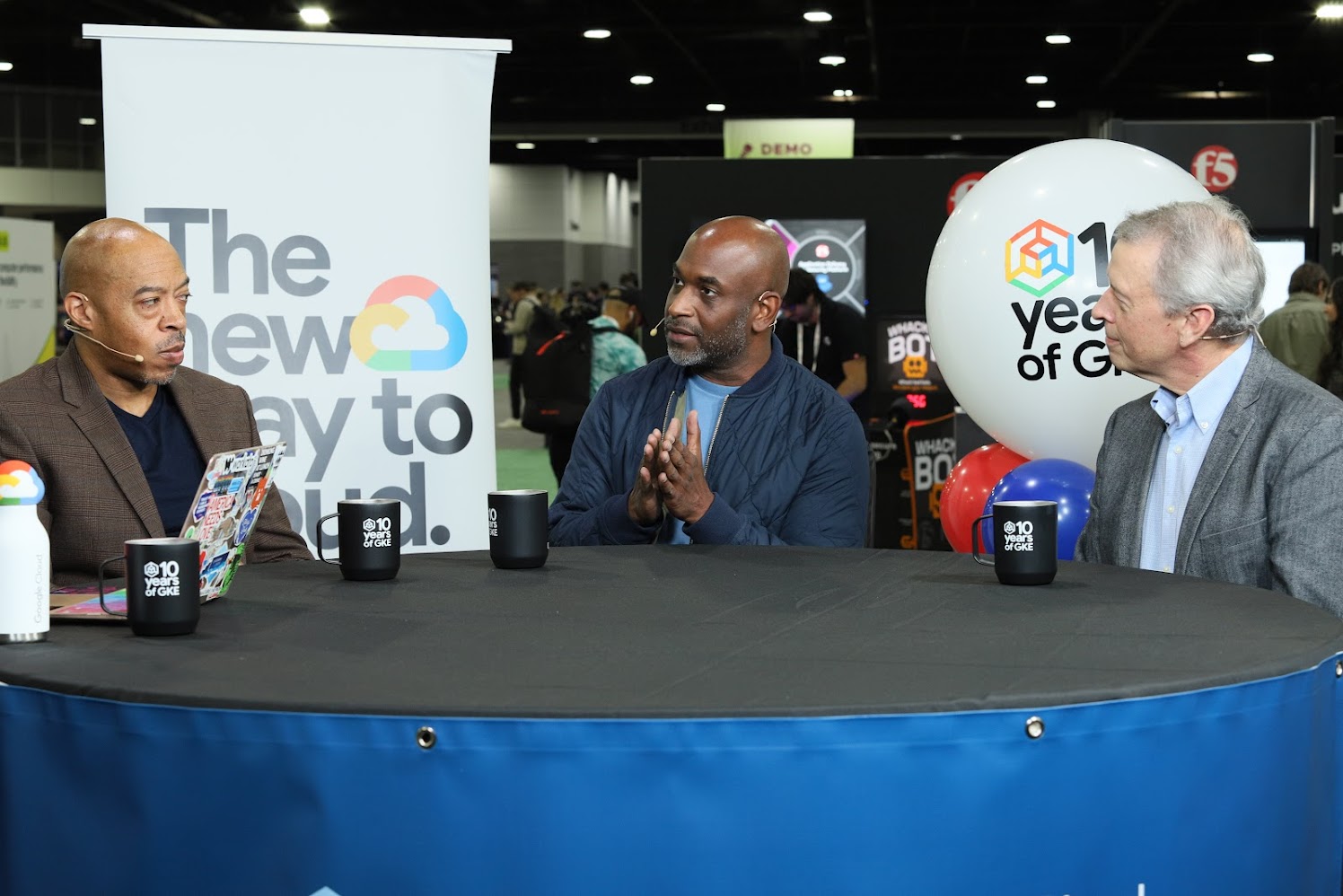
The launch of Google Kubernetes Engine or GKE 10 years ago played a major role in defining how enterprises think about cloud reliability and scale. It also was a key milestone in uniting other major cloud providers around a common abstraction, according to Kelsey Hightower (pictured, center), distinguished engineer at Google Cloud.
Bobby Allen and Kelsey Hightower of Google Cloud, and Eric Hanselman of S&P Global Market Intelligence, spoke with theCUBE about cloud reliability during KubeCon.
“It was the first time that I saw Google Cloud Platform inspire and influence all the other cloud providers,” Hightower said. “It takes what was traditionally infrastructure-as-a-service and makes it one thing. We almost normalized the cloud around this one API abstraction that no one thought was possible, because before that, everything was proprietary. We finally got the cloud providers to agree on something.”
Hightower spoke with theCUBE’s Savannah Peterson at the KubeCon + CloudNativeCon NA event, during an exclusive broadcast on theCUBE, SiliconANGLE Media’s livestreaming studio. He was joined by Bobby Allen (left), cloud therapist at Google Cloud, and Eric Hanselman (right), chief analyst at S&P Global Market Intelligence. They discussed the evolution of GKE as a key resource in enterprise computing. (* Disclosure below.)
GKE’s evolution has followed the arc of cloud environments as they progressed into adaptive systems that combine observability, governance and now automation through AI. Although he was admittedly a skeptic about Kubernetes in the early days, Allen has come to appreciate the orchestration platform’s impact on enterprise computing.
“You couldn’t argue with the number of Google products that are powered by containers or Kubernetes, directly or indirectly,” Allen explained. “I’ve tuned the corner because I’ve seen what the community’s done. I’ve seen what people have built on it, and I’ve seen the openness that Google really gave it away to the community. It’s not about what we’re building, it’s about what we’re empowering you to build.”
That empowerment has led developers to leverage GKE for a number of AI applications. Enhancements such as GKE Autopilot and Inference Gateway have positioned container orchestration as a driver for intelligent infrastructure.
“One of the things that we see in a lot of our end-user study data is that, as we get into AI, there’s this hangover of cloud dependence,” Hanselman said. “[Organizations] want to be able to get to open containers, give them the opportunity to have an interchange, to be able to have that ‘run anywhere’ to deliver on that ‘run anywhere promise.’ And to do that in ways that give them operational efficiency, give them all of the integration and capabilities to be able to build-in the automation orchestration to really make this stuff work the way they have hoped that infrastructure has run for a long time.”
As GKE enters its next decade, there remains a belief among developers that Kubernetes will become ubiquitous and invisible, so widely accepted as part of the enterprise compute infrastructure that no one will know it’s there. That time is fast approaching, according to Google’s Hightower.
“Ten years from now, you’ll be using Kubernetes and not even know it,” he said. “There are a lot of people that are using parts of GCP that have Kubernetes underpinning, and they don’t even know it. I think that just continues for the next decade.”
Here’s the complete video interview, part of SiliconANGLE’s and theCUBE’s coverage of the KubeCon + CloudNativeCon NA event:
(* Disclosure: Google Cloud sponsored this segment of theCUBE. Neither Google Cloud nor other sponsors have editorial control over content on theCUBE or SiliconANGLE.)
Support our mission to keep content open and free by engaging with theCUBE community. Join theCUBE’s Alumni Trust Network, where technology leaders connect, share intelligence and create opportunities.
Founded by tech visionaries John Furrier and Dave Vellante, SiliconANGLE Media has built a dynamic ecosystem of industry-leading digital media brands that reach 15+ million elite tech professionals. Our new proprietary theCUBE AI Video Cloud is breaking ground in audience interaction, leveraging theCUBEai.com neural network to help technology companies make data-driven decisions and stay at the forefront of industry conversations.